What Happens to Walls After Wallpaper Removal?
Most homeowners expect to pull down wallpaper and find walls that are more or less ready for paint. A little touch-up here and there, maybe a quick coat of primer, and the project moves forward.
That is rarely what happens.
What happens to walls after wallpaper removal is usually more involved than expected. The surface left behind is often damaged in ways that are not visible until the room is empty and the light hits the walls at the right angle. Understanding what you are looking at — and what it takes to address it — is the difference between a paint job that looks polished and one that makes you wish the wallpaper was still up.
Why Walls Are Rarely in Good Shape After Wallpaper Comes Down
Wallpaper was not designed to be removed. It was designed to stay.
When wallpaper is installed, the adhesive behind it bonds directly to the drywall paper facing — the thin outer layer that gives drywall its smooth, paintable surface. Over time, that bond strengthens. When the wallpaper finally comes down, it does not release cleanly. It pulls.
In many cases, portions of the drywall paper facing come away with it. In older homes where wallpaper was applied directly over unprimed or unpainted drywall, the bond between the adhesive and the facing is even more aggressive. The damage is not a sign that the removal was done incorrectly. It is a predictable result of how wallpaper adheres in the first place.
This is important to understand before the repair conversation begins. Even when wallpaper is removed carefully and professionally, the walls left behind almost always require work before they are ready for paint. Knowing that upfront means the repair process is not a surprise — it is the expected next step.
Common Types of Wall Damage Left Behind After Wallpaper Removal
Once the wallpaper is down, the assessment begins. What gets found on the walls depends on the age of the home, how the wallpaper was installed, and what removal method was used. Most projects involve some combination of the following.
Torn and Missing Drywall Paper
This is the most common damage type and should be expected in virtually every wallpaper removal project.
It shows up as fuzzy, fibrous patches scattered across the wall — areas where the top layer of the drywall paper facing tore away during removal, leaving the raw gypsum core exposed. The patches can range from small spots around seams to large sections covering most of a wall.
Raw gypsum is highly porous. It does not absorb paint the same way the surrounding surface does. Even after multiple coats, these areas will flash — appearing dull or a visibly different sheen than the rest of the wall.
Gouges, Divots, and Surface Punctures
These happen when removal tools catch on the wall. Scraper corners, seam edges, and the general friction of the removal process all leave marks. The damage ranges from shallow surface scratches to deeper gouges that penetrate into the drywall core.
Depth matters here because it determines the repair approach:
- Shallow scratches can be addressed during skim coating
- Medium gouges need to be filled and feathered before skim coating begins
- Deep punctures that reach the gypsum core require a build-up repair before any finishing work can proceed
Paint follows the surface beneath it. A gouge that is not properly filled will remain visible as a shadow or indentation in the finished coat.
Adhesive Residue and Uneven Texture
After the wallpaper comes down, a film of adhesive is almost always left behind. It may appear as a tacky, yellowish coating in some areas and a barely visible haze in others. In spots where the adhesive was thicker or older, it can be raised and uneven.
Residue has to be addressed before any compound or primer goes on the wall. Paint applied over uncleaned adhesive does not bond correctly, and the texture variation it creates across the surface will read through to the finished coat.
Water Damage and Softened Drywall
When wet removal methods or steamers are used, moisture enters the wall. If that moisture moves beyond the paper facing and into the gypsum core, the drywall begins to soften. Signs include:
- Bubbling or delamination along the surface
- Areas that feel soft or spongy when pressed
- Visible sagging or separation between the paper facing and the core beneath it
Softened drywall cannot hold repairs correctly. Compound applied over a compromised core may not bond, and repairs that seem solid initially can crack as the wall finishes drying. In more serious cases, sections of drywall are too damaged to repair and need to be replaced entirely before any finishing work can begin.
What Repairs Are Required Before the Walls Can Be Painted
The repairs needed after wallpaper removal are not one-size-fits-all. What gets found during the assessment determines what gets fixed and in what order. Most projects work through some combination of these three stages.
Skim Coating Damaged Surfaces
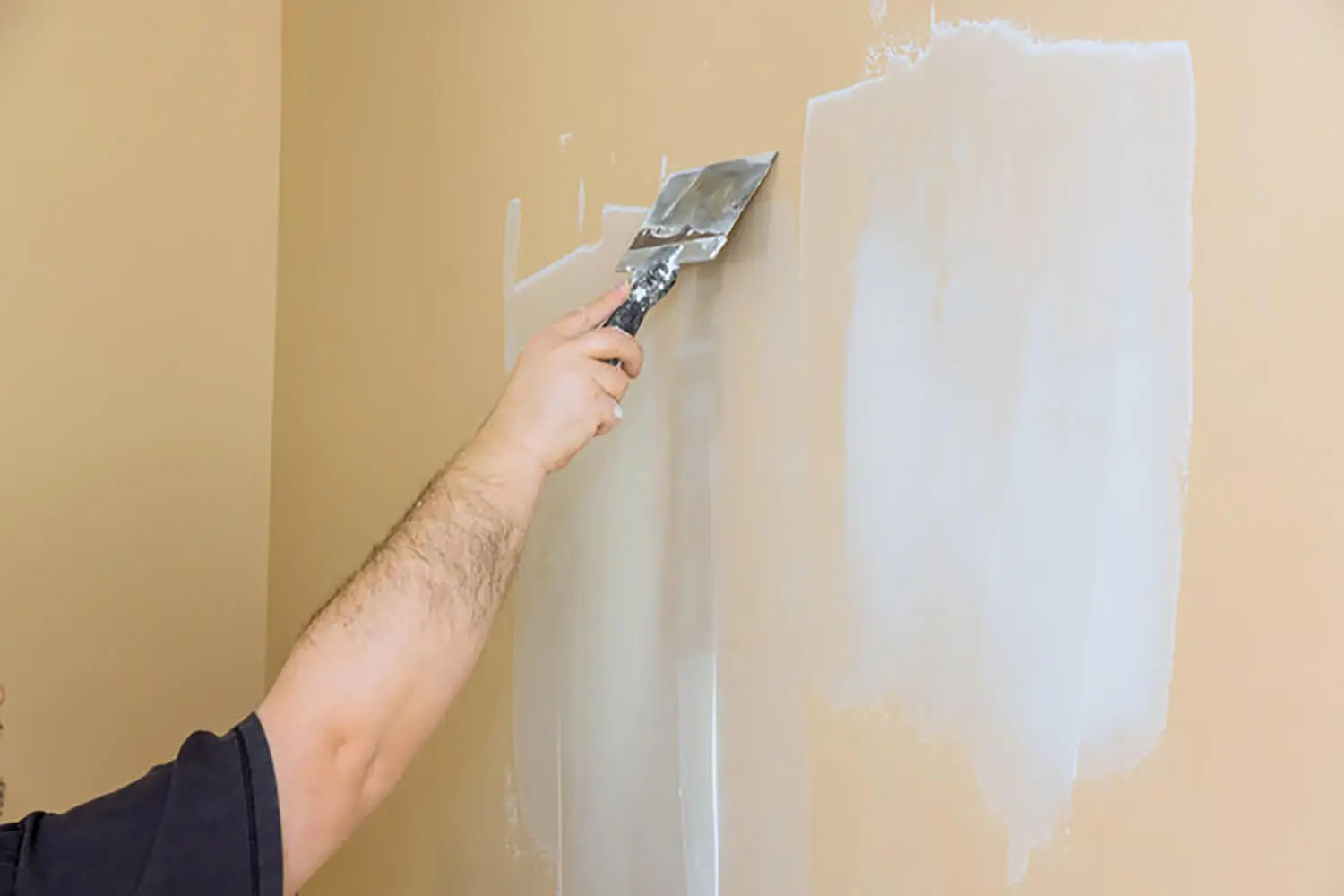
When drywall paper facing is torn across large sections of a wall, spot patching individual damaged areas is not the right approach. Patching each spot separately leaves visible transitions — edges where the repaired area meets the undamaged surface that read through paint as subtle ridges or shadows.
Skim coating addresses this by applying a thin layer of joint compound across the entire affected surface, restoring a smooth, uniform plane. Everything gets leveled together so the wall reads consistently under the finished coat.
The process follows a specific sequence:
- Compound is applied in thin coats — never one thick application
- Each coat must dry fully before the next is applied
- Sanding happens between coats to level any ridges or high spots
- The final coat is sanded smooth before priming begins
A skim coat that is rushed — applied too thick or recoated before it is fully dry — will shrink, crack, or telegraph through paint.
Patching Deeper Damage and Structural Issues
Gouges and punctures that reach into the drywall core need more than skim coating. The repair process for deeper damage looks like this:
- The damaged area is filled with compound and allowed to dry fully
- Additional build-up coats are applied based on the depth of the damage
- Each layer is feathered progressively further out from the repair
- The final surface is sanded flat and blended into the surrounding wall
Feathering is what separates a repair that disappears under paint from one that remains visible as a distinct shape. The compound has to transition gradually — not just cover the hole. Deeper repairs also need more time between coats. Applying the next layer before the previous one is fully cured produces a repair that shrinks back and cracks.
Priming to Seal and Unify the Surface
Once repairs are complete and the surface is sanded flat, primer goes on before any topcoat. After wallpaper removal, this step is not optional.
Raw compound, exposed gypsum, and areas where adhesive residue was cleaned all absorb paint at different rates. Without primer, those differences show up in the finished coat as inconsistent sheen — patches that look dull or flat against the surrounding wall even after the paint dries.
Standard wall primer is often not sufficient after wallpaper removal. The surface conditions left behind — porous compound, exposed gypsum, and residue-cleaned areas — require a primer specifically chosen to seal and unify before the topcoat goes on.
Primer also serves as a final quality check. Once it dries, a professional will inspect the surface under raking light to catch any remaining irregularities before paint is applied.
How Surface Preparation After Wallpaper Removal Affects the Paint Result
There is a version of this project that homeowners imagine and a version that actually happens. In the imagined version, a few quick repairs and a coat of paint transform the walls. In reality, the quality of what goes on the wall before paint is applied is what determines everything about the finished result.
Two walls painted with the same paint, the same sheen, and the same technique will look entirely different if one was properly prepped and the other was not. Prep quality is not a variable that paint can compensate for.
A misconception that comes up often is that applying additional coats of paint will eventually cover surface problems. It does not. Paint follows the surface beneath it — it does not fill it, level it, or seal it. More coats over an unprepared surface add cost and time without improving the result. The problems that were there before the first coat are still there after the third.
Proper surface preparation after wallpaper removal is what allows the paint job to do what it is supposed to do. It is not extra work added to the project. It is the foundation the finished result is built on.
What to Expect When You’re Ready to Paint After Wallpaper Removal
Walls after wallpaper removal are almost never ready to paint. That is not a failure of the removal process — it is simply the reality of what removing wallpaper leaves behind. The path from stripped walls to a finished paint job runs through assessment, repair, and preparation done in the right sequence with the right materials.
Understanding that full scope is what allows the project to move forward without surprises. Homeowners who know what to expect going in are not caught off guard by the repair work. They are not tempted to skip steps to save time. And they are not left wondering why the paint job does not look the way they expected after everything is said and done.
A professional painter can assess the condition of the walls after wallpaper removal, identify exactly what repairs are needed, and handle the full preparation process before a single drop of paint goes on. The result is a surface that is actually ready — and a finished coat that looks the way it should.
If you are getting ready to paint after wallpaper removal, the best first step is having a professional evaluate the walls before work begins. The team at Integrity in Blue can walk through the condition of your surfaces, outline what the repair and prep process involves, and take it from there. Reach out today to schedule your assessment.